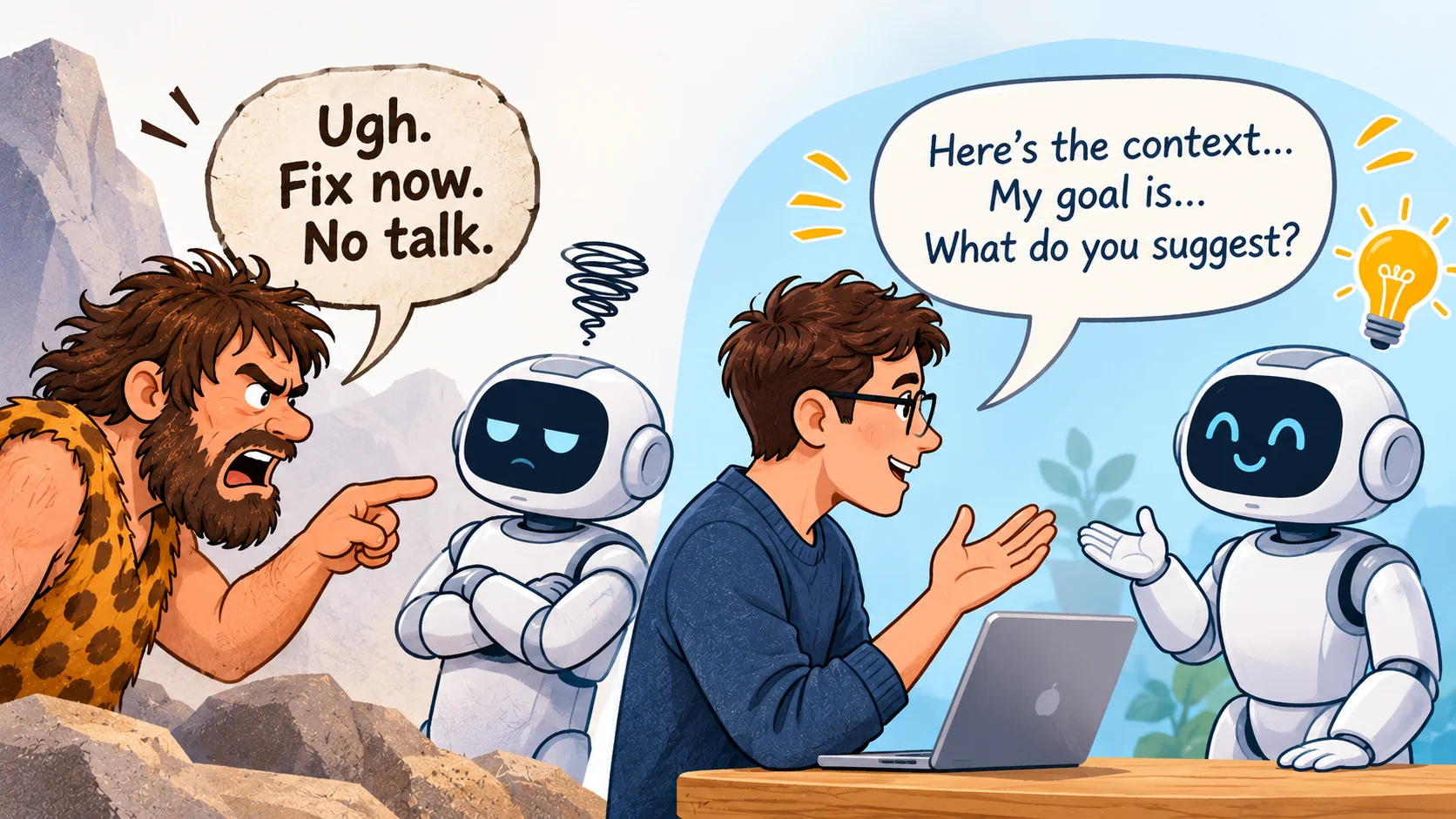
Speak like a caveman? No, thanks. A new trend says you should talk to AI like a caveman — “Ugh. Fix now. No talk.” — and save 75% on tokens. I’m skeptical. Here’s why.
The token math doesn’t work. In a typical coding session (I’m looking at my last one right now), the generated code – implementations, tests, design specs, deployment manifests – dwarfs the conversational exchange by roughly 10:1. Saving 75% on “Fix now” vs. “Could you fix the path traversal issue in the extraction function?” is 75% of a small number. The real token cost is in tool calls, file reads, and code output. Optimizing conversation brevity is optimizing the wrong thing.
Polite communication produces better results — but not because the model is “pleased.” When you say “I’m thinking about business users in HR, sales, marketing who don’t use terminals” instead of “write user stories”, you give the agent framing, audience, and mental model. When you explain why you want a design change instead of just commanding it, the agent understands the constraint and makes better decisions downstream. The courtesy isn’t the mechanism — the clarity that comes with it is.
The real value is collaborative thinking. In a recent session, I started with a vague idea about distributing AI agent skills as OCI artifacts. Through conversation – not commands – we:
- Discovered a dual-format design
- Found out that Kubernetes image volumes eliminate the need for init containers that pull the image
- Aligned with a community specification we didn’t know existed
- Identified that a different AI model catches code review issues the first one misses
None of this was in the original plan. The conversation was the design process.
The caveman approach optimizes for the wrong metric. It minimizes tokens when the bottleneck is thinking, not talking.
I genuinely enjoy having conversations with Claude Code. It helps me put my own thoughts in order. That’s worth more than any token savings.